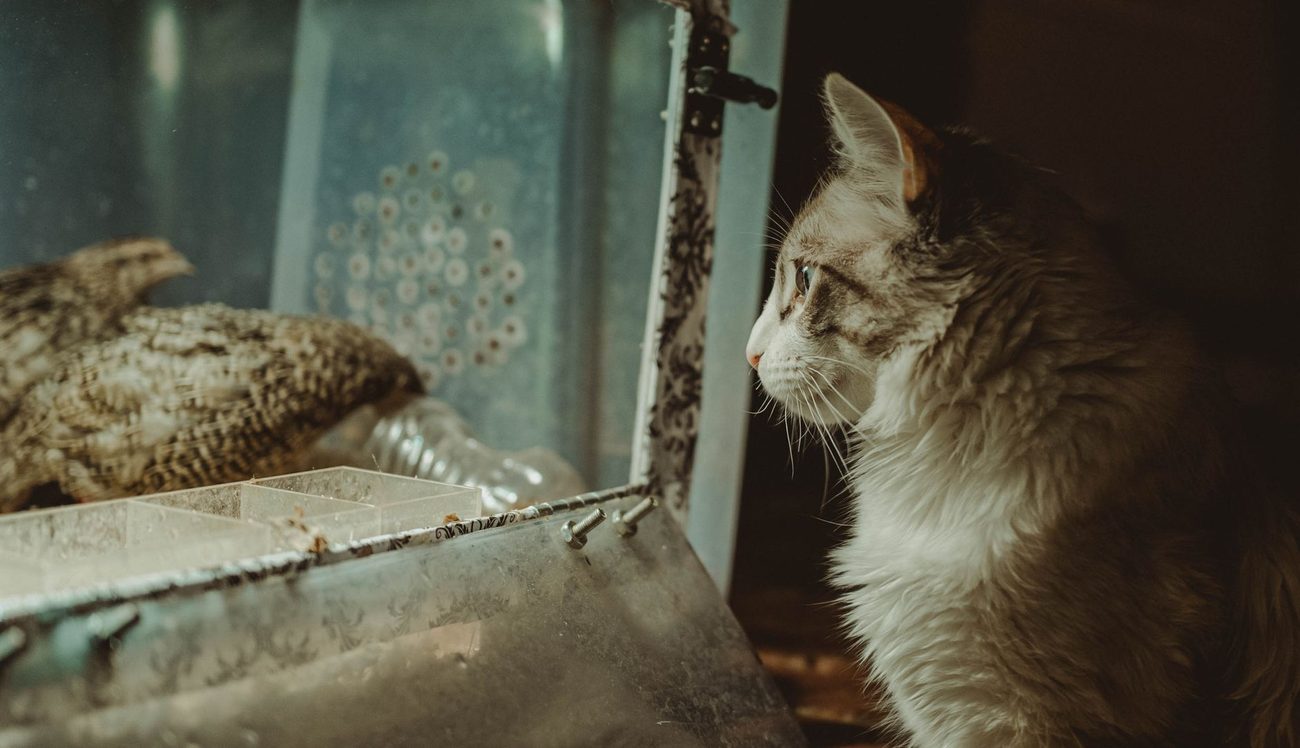
Mabel's bird noise starts around 5:40 in the morning. It isn't a meow. It's a fast, stuttering chatter, half chirp and half click, and it means a chickadee has landed on the feeder outside the dining room window and she would like the household to know she could catch it if not for the glass.
July is peak bird season at our house. The feeder is busy from first light, the windows are open on the cooler mornings, and Mabel, who is nine and has never been outdoors on purpose, has a full-time job. Keeping her busy in summer turns out to be mostly about building her day around that window, plus a little work at mealtime and two short play sessions. Not much gear. A lot of birds.
The feeder outside the dining room window
Caleb set the feeder pole about three feet from the glass. Close is on purpose: a bird that spooks from that distance can't build up enough speed to hurt itself if it hits the window. We also stuck a few decals on the outside of the glass, which Mabel ignores and the birds seem to notice.
The tube feeder gets black-oil sunflower seed, about a 20-pound bag from Fleet Farm every six weeks or so in summer. In July we hang a finch sock too, and the goldfinches turn the whole window yellow. Her lineup most mornings: chickadees, goldfinches, a pair of house finches, a nuthatch that walks down the pole headfirst (this upsets her deeply) and, too often, a squirrel.
The squirrel is the reason Caleb added a baffle to the pole in June. It's also the one visitor that brings Hank. When Mabel's chatter changes pitch, Hank comes trotting in from the kitchen and the two of them stand shoulder to shoulder at the window, which is the closest they ever get. After last December, when a squirrel and an icy backyard ended with Hank in knee surgery, I have no interest in him sprinting across oak floors after one ever again. The baffle stays.
Her window hammock hangs in that same window on four suction cups. In an old house with old glass, I press every cup back down on Sunday mornings, which is not a sentence I ever expected to write.
Making dinner a hunt
Since April Mabel has eaten mostly wet food, two cans a day, plus a small scoop of dry. That little bit of dry is now her afternoon job. It goes into a puzzle ball she has to roll across the floor to shake anything out of, or into a muffin tin with a ping-pong ball sitting in each cup. She works at it for ten minutes or so, then walks away and comes back an hour later to finish, like someone doing a crossword.
On weekends I sometimes hide the dry food in little paper cups around the dining room: under a chair, on the bottom bookshelf, behind the door. Hank is shut in the kitchen for this, for obvious reasons. She finds every one, and then she checks the spots where I hid them last week, just in case I'm getting lazy.
Two short play sessions
Morning and evening, about ten minutes each, with a feather wand. I try to move it like something she'd watch out the window: a flutter up the chair leg, a landing on the rug, a pause, a quick dart behind the door. At nine she plays in bursts. Three serious pounces, then a lie-down where she watches the feather with her tail twitching, then one more pounce right when I've given up on her. I've learned to wait her out.
Every session ends with her catching it, and then food. The evening session ends with her second can. I learned the catching part the hard way, years ago, with a laser pointer. She chased that red dot happily for weeks and then started sitting in the hallway staring at an empty wall, waiting for it to come back. Nothing she could ever pin down. These days she only chases things she can actually get her paws on.
On the hottest days the play waits until after supper, when the living room unit has cooled the main floor and she's willing to move faster than a stroll.
Mabel's verdict: chickadees acceptable, goldfinches tolerated, squirrel unforgivable.